

Industry Insights - Pathfinder FX May
Will Digital Currencies change the cross-border payments space?

There's an undeniable buzz in finance currently around digital currencies, particularly stablecoins, as a solution for cross-border payments. The recent acquisition of Bridge by payments giant Stripe for a reported $1.1 billion highlights this growing interest from major players in the financial tech space. Stripe's move, and their subsequent rollout of stablecoin financial accounts in numerous countries, clearly signals their belief in the potential of these digital assets to change international transactions by offering faster, cheaper, and more transparent methods.
However, it's important to emphasize that despite this significant development and the excitement surrounding it, the adoption of digital currencies for cross-border payments is still in its early stages. While stablecoin transaction volumes are growing rapidly – reaching trillions of dollars annually, they still represent a comparatively small fraction of the vast, multi-trillion-dollar global cross-border payments market, which was valued at $194.6 trillion in 2024. There is an ongoing disagreement/discussion around the actual value using stablecoins as a means of transfer, aside from transfers related to crypto asset trading, very little real-world use for the technology has been shown, apart from enabling business within emerging markets where traditional banking is still slow and manual or currency restrictions apply. The traditional financial rails, with their established infrastructure and regulatory setup, continue to dominate.
There is also the issue of businesses or governments using digital currencies for transactions showing up on a public ledger. This makes organizations uneasy about adopting the technology. Imagine if your competitors or hostile governments could track payments you are making internationally, which could pose a risk to your business or security. This is a factor in the decision of some banks to build private blockchains. Link
The future growth of digital currencies in this sector will depend heavily on evolving regulatory clarity, further technological advancements, and widespread acceptance by businesses and consumers alike. While the potential is immense, it's a long game, and we're just at the beginning.
HSBC has announced the closure of its international money transfer app, Zing, just over a year after its launch.

While Zing was designed to compete with popular fintech rivals like Wise and Revolut, offering multi-currency accounts and competitive transfer fees, HSBC struggled to get traction in this market and ultimately couldn't provide the customer support needed to make this a success.
Existing Zing users were able to continue using the app until April 2, 2025, for transactions and withdrawals, with accounts officially closing on May 22, 2025. Customers were advised to transfer any remaining funds before this date. Link
Currency Dealer Argentex is struggling with recent volatility.
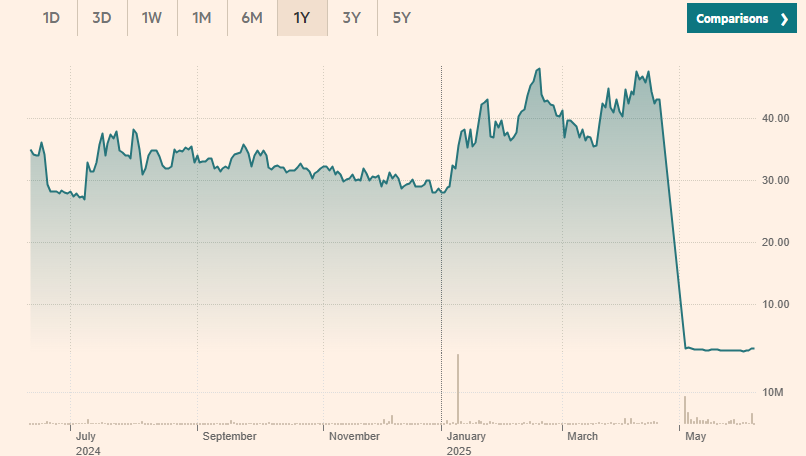
Listed currency dealer Argentex Group PLC has been facing significant financial challenges, leading to its shares being suspended from trading on London's AIM market in April 2025. The company's troubles stemmed from a liquidity crisis, primarily triggered by substantial margin calls on its foreign exchange forward and options books, a result of heightened FX market volatility, particularly the rapid devaluation of the US dollar.
Argentex has been in urgent need of capital, leading to takeover interest from several parties. While some suitors have withdrawn their interest, IFX Payments has emerged as the primary bidder, offering a conditional acquisition. Argentex has also secured a revolving credit facility and a bridging loan from IFX Payments to help meet its immediate liquidity needs. Most recently, Argentex rejected a proposal from Lavide Holding NV, stating it did not represent a full offer for the company and fell short of the required funding. The situation remains fluid as Argentex works to secure its future and protect value for its stakeholders. Link
If you have been affected, get in touch.
The EU set to remove Dubai and others from the black list

Great news brewing for the United Arab Emirates (UAE). The European Commission is set to remove the UAE from its list of high-risk countries for money laundering and terrorist financing. If this goes through, it's a significant positive step for the UAE's international standing, and crucially, for anyone transferring money to or from the UAE or making international payments involving the region. Link
This move by the EU follows hot on the heels of the global financial crime watchdog, the Financial Action Task Force (FATF), which already gave the UAE the green light back in February 2024, removing them from their own "grey list." This shows a clear recognition of the UAE's efforts to strengthen its financial oversight and combat illicit financial activities.
Now, this isn't the first time the EU has considered delisting the UAE. There was a similar proposal last year, but it faced a roadblock in the European Parliament. However, it seems the European Commission has been working to address those earlier concerns, particularly around judicial and law enforcement cooperation. They've acknowledged the progress made and stated they'll continue to "closely monitor the implementation of these measures."
Why Does This Matter for Your Payments?
Being on the EU's high-risk list, which the UAE was added to in March 2023, triggers stricter financial scrutiny from EU institutions. For banks and financial service providers in the EU, this means:
Increased Due Diligence: More paperwork, more questions, and longer processing times for transactions involving the UAE.
Higher Costs: Banks passed on increased compliance costs through higher fees for international transfers.
Potential Delays and Rejections: Payments were held up or even rejected more frequently due to the enhanced scrutiny.
"De-risking" by Financial Institutions: Some banks reduced or ceased their operations with certain entities or in the region altogether to avoid perceived risks.
So, coming off this list is a big win. It could lead to smoother, potentially faster, and even cheaper financial transactions between the EU and the UAE. This boosts investor confidence and could certainly pave the way for closer economic ties, like the potential free trade deal recently discussed between Commission President Ursula von der Leyen and UAE President Sheikh Mohamed bin Zayed Al Nahyan.
What Else is Changing on the EU List?
Beyond the UAE, the updated EU list is also expected to see several other countries removed, including Barbados, Gibraltar, Jamaica, Panama, the Philippines, Senegal, and Uganda. This could similarly ease financial interactions with these nations.
However, it's not all removals. Some new countries are set to be added to the list: Algeria, Angola, Côte d’Ivoire, Kenya, Laos, Lebanon, Monaco, Namibia, Nepal, and Venezuela. If you deal with these countries, be prepared for potentially more stringent checks and longer processing times for your international payments.
This proposed change for the UAE signifies a positive shift and reflects the sustained efforts they've made to enhance their financial integrity. It's a key development for anyone involved in international payments or money transfers with the UAE. We'll be watching closely to see the final decision!
The Pathfinder Team
Get in touch +44 (0)1743 290955
Comments